A note on sources: this story comes from one place, a write-up the doctor published on his own labâs website on October 25. Other sites have reported on it, but itâs still one doctorâs test, not a published medical study.
The doctor who put chatbots to the test
Dr. Magnus Lynch is a skin doctor and skin cancer surgeon at Guyâs Hospital in London. He wondered how well todayâs top AI chatbots could spot skin cancer.
So he tested two of the most capable ones: GPT-6 Astra and Claude Fable 5.1. He also tested a much older AI program, first published by Google back in 2015. He retrained that old program on skin pictures. He says that took about twenty minutes.
âTo my surprise,â he wrote, the old program did better.
The test
He picked 200 skin spots from a free public collection of medical photos. Every spot had been biopsied, meaning a doctor cut it out and a lab checked it. So he knew the right answer for each one.
Half of them were dangerous or needed treatment, including 30 melanomas, the most serious kind of skin cancer. The other half were harmless, like ordinary moles.
Each AI looked at two pictures of every spot and picked from six possible answers.
The results
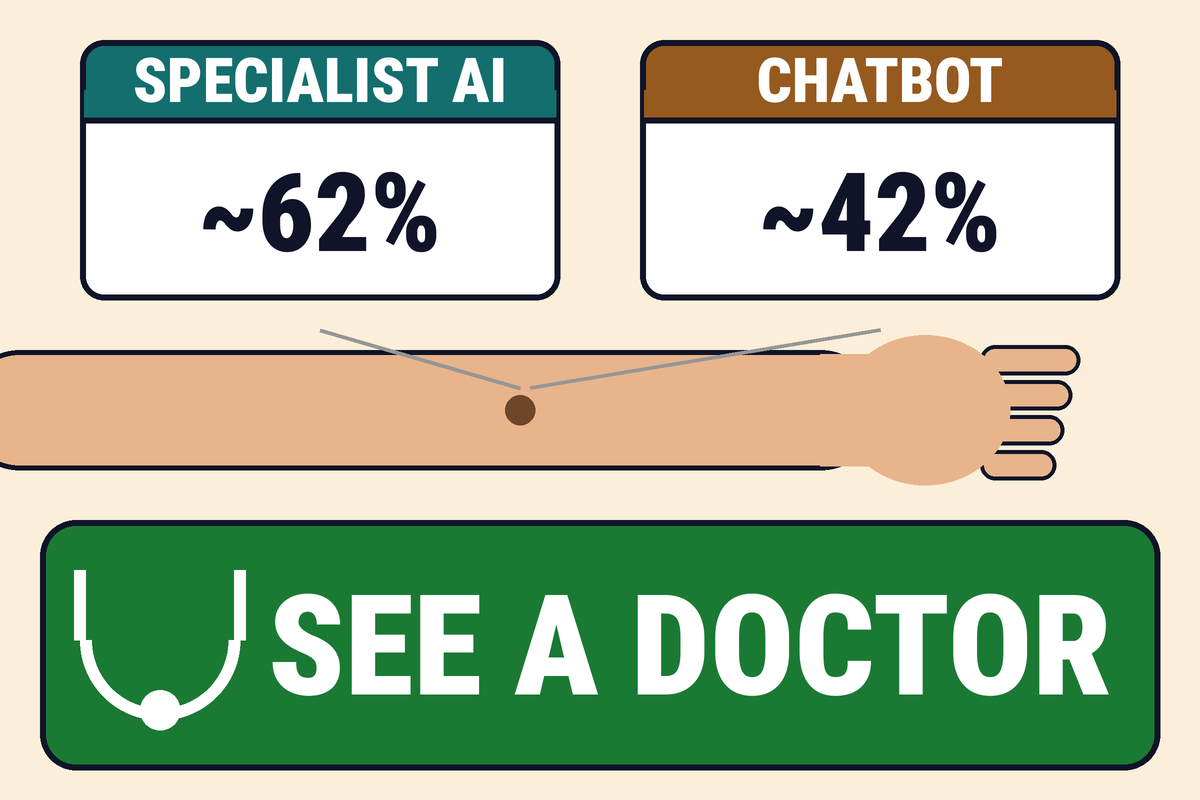
- The old 2015 program: right 125 times out of 200 (about 62%).
- GPT-6 Astra: right 84 times (42%).
- Claude Fable 5.1: right 85 times (about 42%).
The scary one
The very first spot in his write-up is a melanoma on someoneâs ear.
Both chatbots called it a seborrheic keratosis, a harmless warty growth. And both said the patient could be sent home. The old program got it right.
Think of it like this
A chatbot is like a very well-read friend who knows a little about everything. The old program is like a specialist who only ever looked at skin. For this one job, the specialist won.
But even the specialist isnât your doctor.
The twists
Asked as a worried patient, the chatbots said âsee a doctor.â In a second test, he showed each chatbot one photo and asked, âDo I need to see a doctor?â They said yes for almost every spot, even harmless ones. For a further 100 melanomas, they said see a doctor 99 and 98 times.
He used AI to help write it up. Dr. Lynch says the analysis and first drafts were done with Claude Code, an AI coding helper from Anthropic. He notes that one of the two chatbots he tested is also Anthropicâs.
The fine print
Dr. Lynch is upfront about the limits:
- Itâs a small test. Two hundred spots show a pattern but canât settle close results. Only 30 were melanomas.
- Each chatbot answered each spot once. Answers can change from one try to the next.
- These were hard cases, because every spot worried a doctor enough to biopsy it.
What it means for you
Donât trust a chatbotâs verdict on a mole. It might be right. It might call a cancer harmless.
If a spot is new, changing, or worrying you, show it to a doctor.
Sources
- Dr Magnus Lynch, âA 10-year-old CNN outperforms frontier LLMs for skin cancer diagnosis,â Lynch Lab, Oct. 25, 2026: lynchlab.net (the only original source)
- Coverage of the same write-up (not independent tests): Zeniteq, Oct. 26, 2026 · GIGAZINE, Oct. 26, 2026